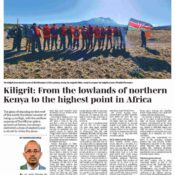
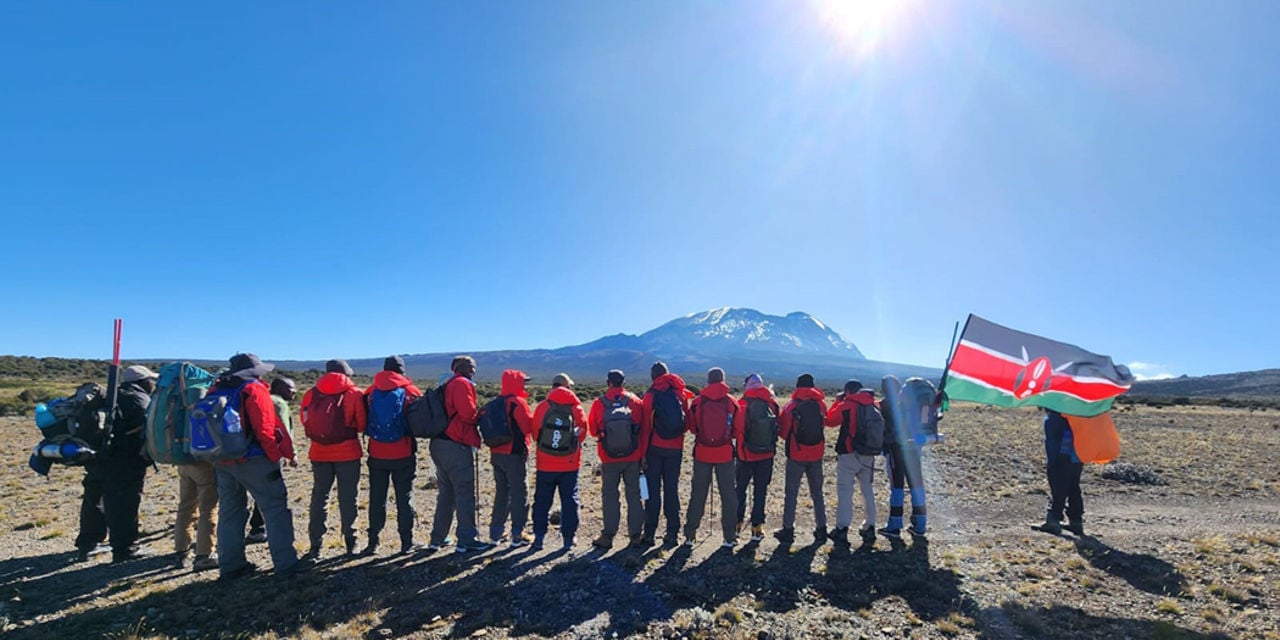
The Kiligrit team stands in awe at Mt Kilimanjaro’s Shira plateau, facing the majestic Kibo, ready to conquer the heights ahead. #PeakPerformance.
By Abdiwahid Biriq
In my native language, the highest peak is really a small hill, and they call it a mountain. The folks in northern Kenya may have heard about the stratosphere-scrapping mountains, but believe that the Most High Lord intended these summits to be out of bounds for the earthly mortals.
According to folklore, it is only insanity or mental disorder that will drive a man to the hills, and that is why we have been quiet about our little adventures. Nature abhors anything that disrupts its quietness and the general norms. To inform the village elders that we have been to the peaks of these mountains that stretch into the near-heaven is to invite a ceremony to exorcise evil spirits from self.
Despite thousands of bitter moments of regrets, we have so far stood at the summits of Mount Kilimanjaro, Mount Kenya and Mount Meru a total of 10 times and still counting. Friends and strangers alike have never given up asking, and we have never tired of telling them. The glory of standing on the roof of the world; the sheer wonder and exhilaration of being up so high, with the world and the endless expanse of the African plains spread out below us, and being above the clouds that look as if it’s an endless ocean, has always delivered a dose of euphoria and the urge to relive the same.
Read: The Ultimate Guide to Hiking in Kenya: Top Trails and Tips
Climbing mountains is an experience that is hard to put into words. To many, hiking evokes the joy, the elation and the mystique of wandering in the wilderness. These are the reasons why the Kiligrit team keeps returning to Africa’s most elevated natural wonders.
And so after a breakfast meal that felt like the last supper, the team once again boarded the bus to begin the journey to Kilimanjaro. The bus was tortuously slow, and will not even overtake a truck that will have lost a race with a tortoise.
When in Tanzania, you must learn patience, and this may be the reason why our matatus (public commuter vans) look like scrap metals wielded together, and theirs don’t. Their road rails have no scratches and still stand as built. In Kenya, it is unusual to find a road rail or a barrier that is still intact and not vandalised.
Three hours later, we arrive at the park gate. After registration and weighing, we begin the trek through the forest, walking under a tangled canopy of moss-coated vines that bring you into contact with nature’s wonders. In silence, you may hear the trees are talking to you – whispering words of advice.
Usually at such early stage of the climb, people are generally animated – full of conversation. The chattering diminishes as you climb higher. Even the smartphones get tucked away.
The energy sapping warm temperatures and high humidity slow down the pace. We stop to shed more clothes, but the red jacket stays on. Hikers are generally fascinated by our red jackets. Many would call us the ‘red army’. With three former military officers in our midst, the title may be appropriate. We walk in single file, in step and with purposive strides.
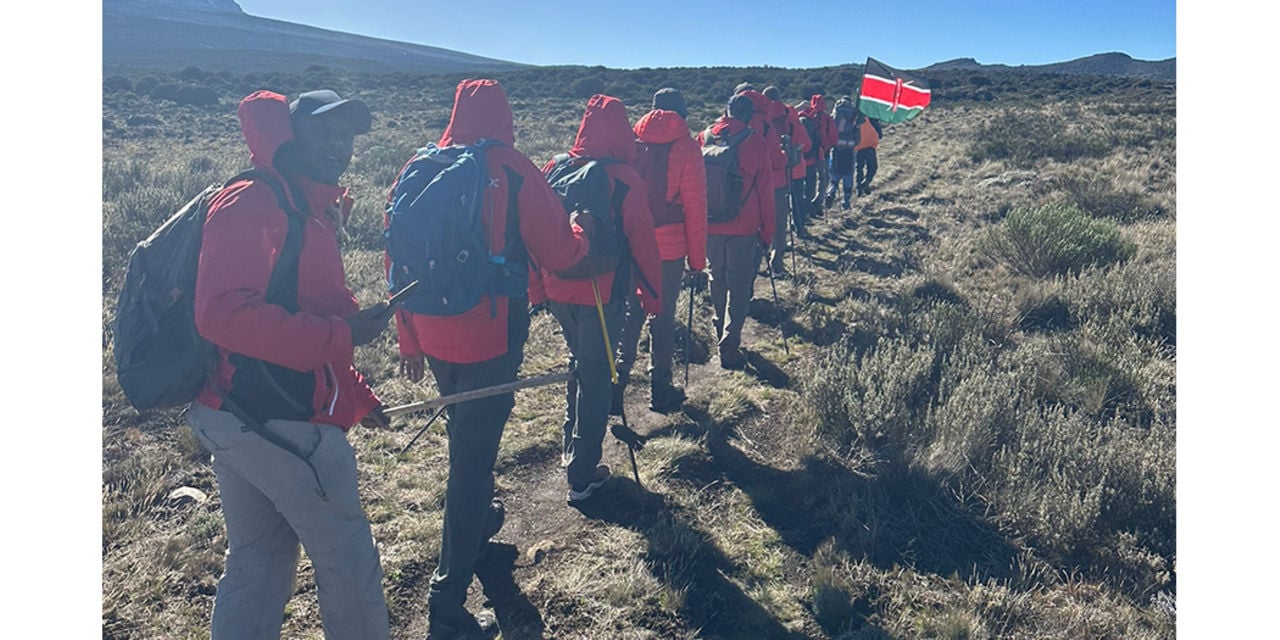
The team braves the rainforest’s morning mist on their ascent, forging ahead with determination.
At 73, Babu is in his element
Mzee Hussein Ahmed Farah, fondly referred to as Babu, is a former colonel in the Kenya Air Force, and one time the head of the presidential fleet. Babu has flown every head of state and government who visited Kenya during his time, including Margaret Thatcher, Indira Gandhi, and Trudeau of Canada. At 73, Babu is in his element when he is negotiating tough terrains, near-vertical and steep rock face, scrambling over boulders or groping for something solid to hold onto before heaving himself up to a safe ground.
It takes a certain strength, both physical and mental, to climb and return to Mount Kilimanjaro, Mount Kenya, and Mount Meru. For Babu, the biggest challenge is generally not the cold and the hours spent walking and climbing across ridges, hanging rock faces and dealing with low oxygen level. His biggest concern is finding a pot of tea made to his specification, with the correct combination and mixture, and honeyed to his taste. There is something in the nature of tea, brewed to brownish colour and with the correct amount of camel milk. It settles nerves, rejuvenates, and energises as to reawaken the inner self-belief.
One man who understands Col Farah is his long-time business partner, Maj (Rtd) Hussein Unshur Mohammed, formerly of the Kenya Army. Together with their third partner, Capt Mohamed Adan, they built Bluebird Aviation Limited, arguably the most successful airline in East and Central Africa.
HM is the golden thread
Maj (Rtd) Unshur, who is more commonly known as HM, is the golden thread that holds the team together. His natured discipline, meticulousness and singular focus on effectiveness, cannot merely be attributed to his military training. He may have inherited this rare trait from his father, a colonial paramount chief in the former Wajir District.
HM approaches issues like a man with a mission – always seeking to eliminate the possibility of later dealing with psychic obstacles associated with failure. However, he may have missed the briefing on the rules on the mountain – which is that you must always listen to your body, notwithstanding your level of mountaineering experience. Sometimes each climb feels harder than the last one, and your body reacts differently each time. The reasons could be varied: Loss of appetite and thus failing to nourish your body adequately; eating but not keeping the food in; sleep deprivation; and a myriad of other reasons associated with altitude sickness.
I learnt that toughness, willpower, and sheer determination can both be a positive and a dangerous trait to have on the mountain. This trait seems to run deep in the military men. If we belonged to a writing culture, HM and Babu would have by now had several books to their names.
An endowment in persistence
Col (Rtd) Abdulbari Abdirahman comes from a military family. His father was the first African to command a battalion in Kenya. Col Abdirahman, the father, spoke many languages: Luo, Kalenjin, Kisii, Kikuyu, and his native Somali. He famously walked out of a presidential function when the Defence Minister disparaged the Somali community. It is likely that he was overlooked to command the Kenya Army because of his tribe and the Shifta war.
Col Abdulbari epitomises the proverbial hare and tortoise. His slowness and appearance of clumsiness is, however, deceptive. He has a 100 percent summit record, showing an endowment in persistence, perseverance, and an enviable ability to override pain, probably learnt during his many years of military service.
The other team members include yours truly; Abdikadir Sheikh Hassan (speaker), an advocate practising in Nairobi; Mohamud Issak Duale, a humanitarian expert and team ‘doctor’; Hassan Sharif, the team’s spiritual Monk and the only hiker I know who never uses a hiking stick; Omar Sholli Adan, the bulldog; Ali Daud, an environmentalist; and Mohamed Elmi (Fay), former minister in the coalition government. Fahim Hussein, an aviator; and Ali Farah, a prominent farmer; are also part of this great adventure.
The first and second nights are generally considered to be the coldest. At least that is how it is perceived. Of course, they are not by any measure. At 5am, you struggle to leave the warmth of your sleeping bag. You listen to the bitter arguments between body and mind, crawl out of the tent and commit to the freezing cold outside. All the tents come to life followed by 10 minutes of grief, grumbling and self-pity.
Nature’s refrigerator has a way of testing human endurance. The Mercy of the Most High Lord is given to the mortal who ask of Him. We gather to perform the early morning prayers. You push away the thin ice coverings and scoop the water for washing and for ablution.
You go through several layers of clothing to reach your frozen extremities, release the content of the bladder, and wash with the icy water that knocks the life out of it, and proceed to perform ablution. At least nobody gets burnt here. We learnt from past experience. It was early morning on Mount Kenya, when I heard repeated lamentations in the dark: Oh, how will she be told! Poor guy, he almost burnt himself but the feared trouble seems to have been averted by other means. Being frozen temporarily, it is agreed, is less damaging than being scalded by hot water.
After breakfast, the team troops out of the camp with speaker running a commentary on the happenings in the night before. The dwellers of the forest canopy are announcing to their neighbouring tribes that they have survived the night. The rustling and whispering of the trees would generally awaken his inspiration. We stop once again for Babu’s blockbuster stories remembered from moments in bygone days.
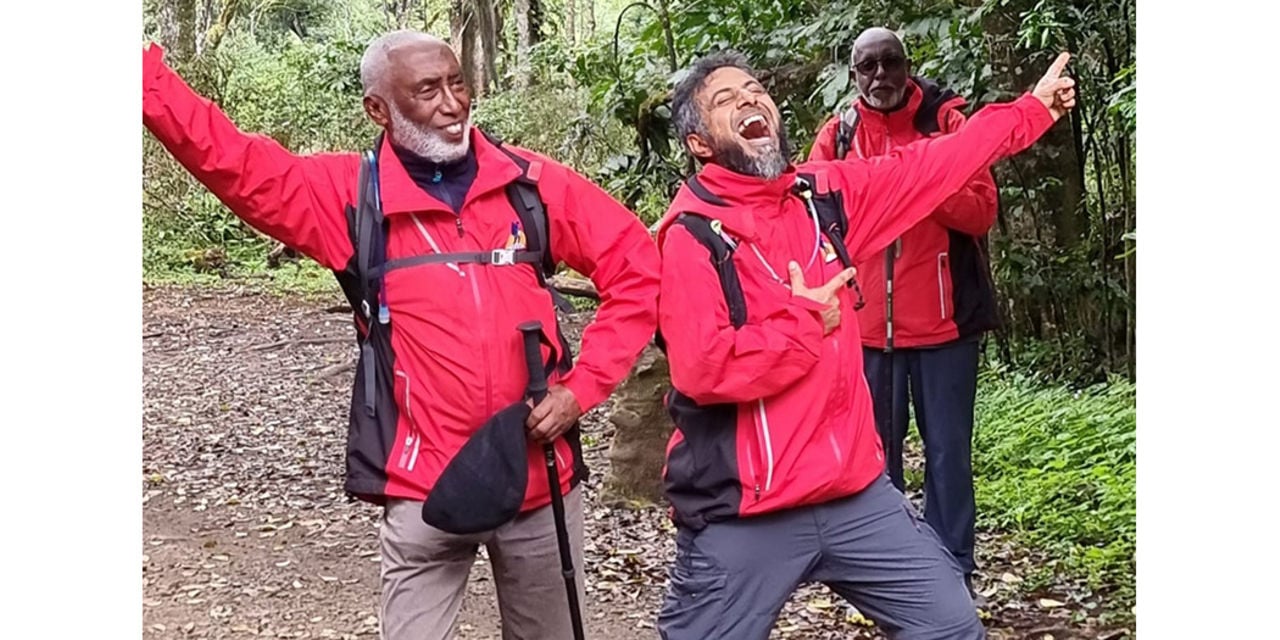
Posing for a giggle break! Babu and the Monk are fuelling up a light moment halfway through the climb.
Two hours later, we leave the forest behind and abruptly come to the open plains with the billowing clouds hovering just above the high brushes. Col AB is singing melodious but mournful songs to help him deal with the sudden pressure on his breathing. Babu sings along and I can see Mohamudu moving his body rhythmically.
Ali Daud is explaining the scientific aspects of this phenomenon and even supports it with the words of the Almighty Allah: “Whoever Allah wants to send astray – He makes his breast tight and constricted as though he were climbing into the sky” (Qur’an 6:125).This period of cheerfulness is disrupted by a burst of angry wind as if sent by the spirit of the mountain that perhaps does not like to hear grown up men grunting to their boyhood fantasies. We are on the move again.
All hurried to make calls
Suddenly, the phones come to life. There are beeping sounds coming from every individual. We all hurry to make calls home before the phone network is lost. Many scramble to locations away from earshot, stationing themselves at the nearest high point – over boulders and on precarious imbalances. This comes at the right moment as speaker begin complaining about not having the mandatory water break.
A man who is always hit by altitude sickness and throws up uncontrollably, but finds no excuse to rush down the mountain. Calls are made, worried wives are assured and with-it peace returns to the Shira Plateau.
We reassemble to file behind the lead guide. With the fear of twisted ankles and wrenched knees passed, we journey up the mountain. The clouds clear and Kilimanjaro, a solitary mountain sprouting out of the depth of the earth to tower above the African plains, stands proudly before us, unconcerned about the tiny creatures willing to take the gruelling and treacherous journey to its highest point. The Monk is still on his phone barking out orders to some site workers.
On the fourth day, we head early for Lava Tower, a large, rocky outcrop that marks the transition from the moorland to the alpine desert, for lunch under its shadows. Several members struggle. The Lava Tower just smiles at them. A surge of cold wind billows – a form of sign language of the mountain. All below is white cloud, all above is blue. We are momentarily slow, breathing heavily as some members complain of drums starting to beat in their heads. We crawl into a large tent serving as a dining mess for a hot lunch. Outside, the clouds are gathering.
Shortly, it starts snowing, which probably worries Ramadhani, the head guide, about the strenuous hike that is between Baranco camp and us, and the treacherous long drop into the gorge below. You quickly learn that the weather in Kilimanjaro is as moody as a hiker with lingering doubts, who looks for blame anywhere. With the energy level boosted, we are on the move again to navigate the long treacherous drop.
Sholly stops jumping between rocks and pays more attention on where to tread. The sun is out again, melting the snow.
No one stops to take photos or look up to enjoy the vistas of the mountain, the rivers or the breath-taking view of the landscape that stretches out below us. Safety is fundamental.
Out of the gorge and into hours of walking inside an old lava flow beside a cold, clear, gurgling mountain stream, the sun breaks through again to lighten up the mood, but it disappears as fast as it appears, under thick waves of clouds. Intermediate rain and drizzles take over. We walk in the thick fog. The group at the back are not seeing the team in the front. Half of the team are invisible to the other half.
Several hours later, a billboard announcing Baranco Camp suddenly appears in the midst of the fog, only 50 yards away. The sun breaks through again, revealing the near vertical monstrous Baranco Wall that we are expected to negotiate the next morning.
The Baranco Wall
Over breakfast, someone announces that he did not have a wink the previous night, saying he kept falling from the mountain time and again, only to be caught mid-air in the nick of time, each time. His loud snores had apparently been heard from the neighbouring tent.
Shortly after breakfast, the team is on the move to confront the strenuous Baranco Wall, a steep, nearly a kilometre-long rock face that requires the hiker to scramble over and across boulders using hands.
In some parts, an outcrop protrudes out into the pathway over an edge of a cliff, with a drop that looks like it is ending at the bottom of the earth. It has just enough space if you put your feet sideways and one after another as you stretch your hands across it in a bear hug position, you then press your face against it and inch your body forward and around it as you grope for something solid to hold onto whilst never daring to look down.
My heart is beating so fast and loud. I’m afraid it is about to cause the brain to send wrong instructions to my feet and hands. Your safety is dependent on steady hands and feet, a clear mind, and listening to the ever-present guides, and of course a soul with no lingering doubt.
After something that felt like eternity, we are out of the danger zone and are gathered at the top of the cliff to reassure the shaken individuals. It is difficult to assess whether the thumb-size droplets on our faces are as a result of perspirations or from the drizzle.
The experience will undoubtedly touch the psyche of all mountaineers who have undertaken its challenges. We soldier on behind the Kenyan flag carried at the head of the line, occasionally stopping to give way to the porters, often with a 20kg load balanced on their heads. They effortlessly move past us. They are the heroes of the mountain.
The sun hides behind the clouds for the better part of the day. Our horizon is never beyond few feet away. Mohamudu is animatedly describing in the third person the Baranco Wall crossing experience. HM is describing the unparalleled feeling and the enjoyment he experienced. I consider asking if we can do it again, but drop the idea immediately when I see the apprehensive faces. The response will surely be in the negative. We move on.
Our legs feel the strain as we traverse the rugged terrain made more difficult to negotiate by the drizzle that has refused to go elsewhere. Instead of going up, we are now going down. The rule is that if you go down, you must come up, which generally means a long punishing ascent. The conciliation is that the camp is at the top of the out-climb. As it may always be the case, by the time we reach camp, the porters have already set up everything.
Day five: We are at Barafu camp. This name may have been given once upon a time when the camp was covered in polar glacier. Ice and snow are the lifeline of the mountain. It is now as strangely bare and windy as the Sahara Desert. The mountain is dying. Even places where four years ago we were trudging through foot high snow and ice, are now cpvered in dry, volcanic dust.
I lie down in my tent, wearing all my clothes inside the sleeping bag, shivering and panting from the exertion from the effort of going into the sleeping bag. It is summit night.
The race to Stella Point
We leave the base camp in the middle of the night dressed like Eskimos. It is brutal. We puff and heave. Despite all the acclimatisation, we are weak, each step slow and arduous. With each step, dry, volcanic dust puff and swirl around us. I spend most of the night journey wondering which would explode first, my heart or head. My head is pounding so loud that I fear my brain content will ooze out any moment.
My hands and feet are also painfully numb, and nostrils are burning. The remaining part of the night is spent regretting and having unintelligible thoughts. I push on, goading myself into facing a type of pain rendered from ordinary human existence. The trail twists and turns, and cuts back and forth.
Every few minutes, we inch past a dazed climber on their way back down from their aborted attempts. We witness a guide standing over a climber doubled over and vomiting, the altitude having gotten the better of him. Walking pole pole (slowly) and having frequent intake of water is recommended as an antidote to the implicit limitation inherent in any human being facing altitude sickness. Generally, there is no way to predict how altitude affects you. You will discover that the fittest can be laid low whilst the fattest may be unfazed.
Gradually, the sun peaks from the horizon and Stella Point appears just above our heads. But the body refuses to be rushed. One and half hours later, we are standing at the summit – one of the nearest points to space. It is likely that we are higher than anyone else on the planet at that moment.
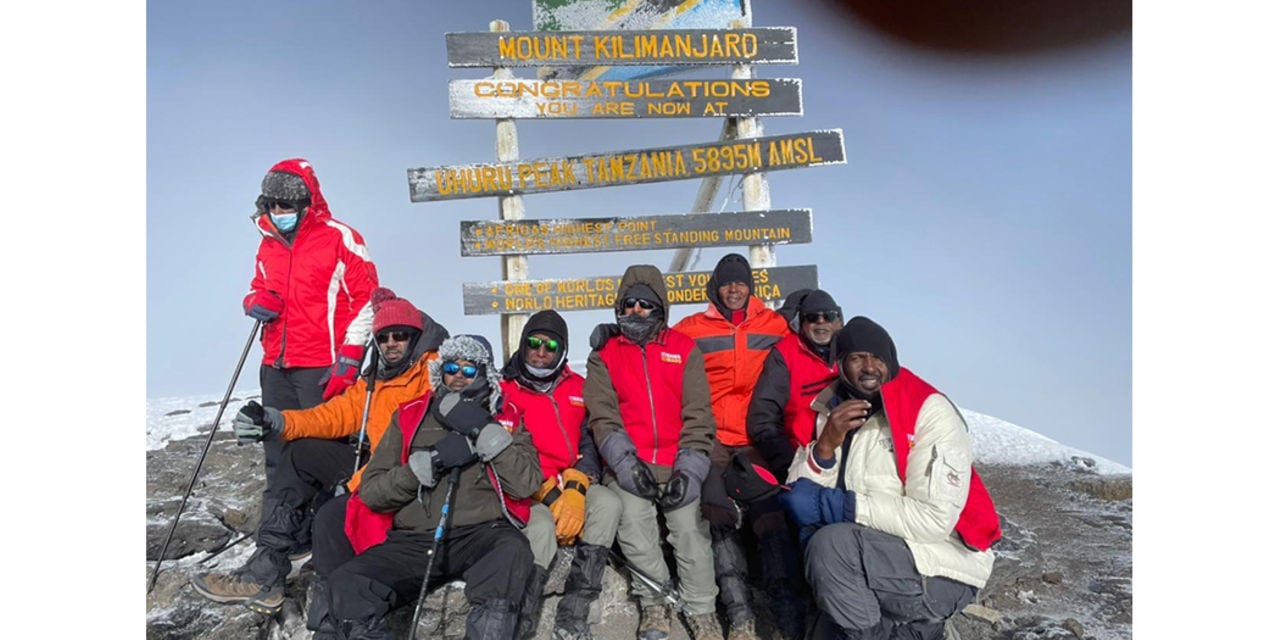
Breathless and triumphant atop Uhuru Peak, the roof of Africa, Kiligrit team shares a moment of sheer exhilaration and camaraderie. Together, they’ve scaled the heights of both the mountain and their resilience, etching memories that’ll last a lifetime. #SummitGlory.
The sheer wonder and exhilaration of being so high, with the world spread below you and looking down on the clouds, peering beyond the curve of the earth, is the reason we go through this hellish experience and continue to return to it. As they say, what goes up must come down. We begin the long descent taking the knee-jarring downward path through scree on the slopes.
Kilimanjaro is most certainly not an easy climb, and those who plan to make the journey must be prepared to overcome the numerous challenges.
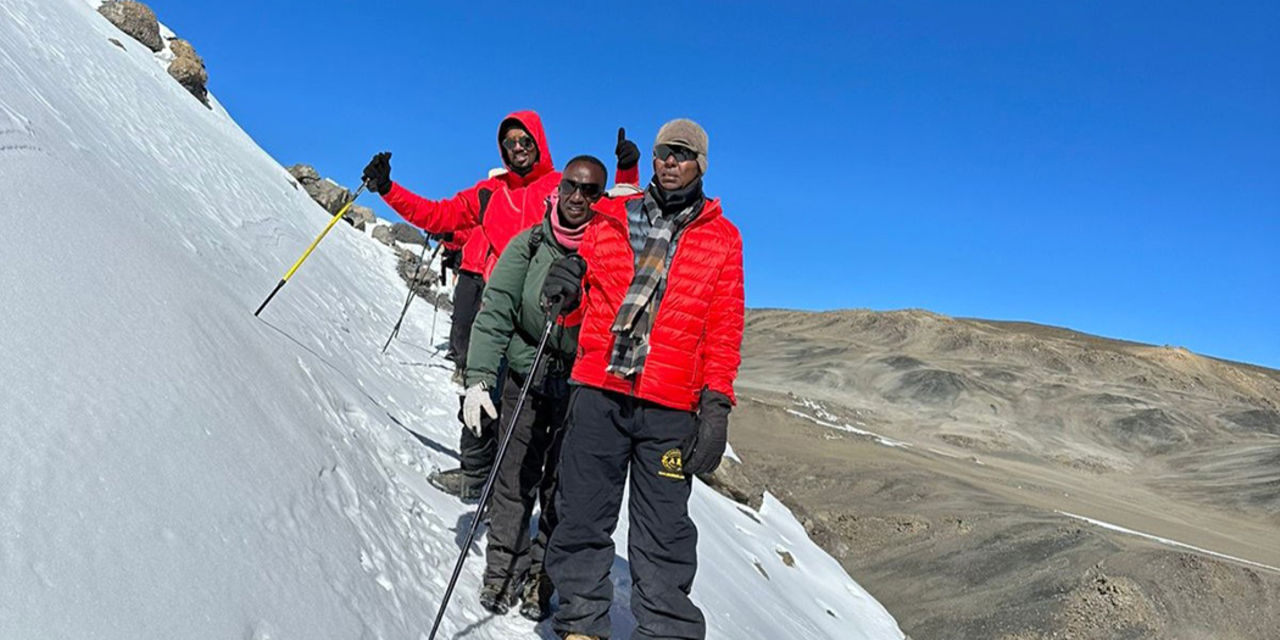
Conquering heights: Team descends from Uhuru Peak, the summit of Mount Kilimanjaro, amidst a stunning snowy landscape.
In the spiritual world, a mountain is a place that inspires awe, challenge, and a sense of connection with something larger and more enduring than the self: The Creator – one other reason why Kiligrit derives energy from the mountain and continues to return there however exhausting and treacherous the relationship has been.
Abdiwahid Biriq is a senior partner at Sagana, Biriq & Muganda Advocates LLP / (@ABiriq)
First Published in the Nation Newspaper