By Abdiwahid Biriq
Any trip by a large group (11 members in our case) would require meticulous planning, including designing an itinerary, securing reliable transport and accommodation. Kiligrit’s trip to Namibia was no exception.
Now, there are no direct flights from Nairobi to Windhoek, Namibia’s capital. The world gets there through either Addis Ababa in Ethiopia or Johannesburg in South Africa. Kenya Airways flies to Johannesburg, thus requiring a connection from there to Namibia through another carrier. After much logistical considerations, we opted for the Addis Ababa route, which meant using one carrier – Ethiopian Airlines.
Even then, it meant that we fly over Kenya both ways, prolonging our journey. Imagine you are in Kisumu and you want to go to Kampala by road, but to get there, the bus has to first go to Nairobi to pick other passengers, and back through Kisumu on your way to Kampala.
We checked in and proceeded to the immigration desk where usually, your passport would be scanned, then your photo taken. You are then asked to place your index finger on the fingerprint reader. After this, you place four of the right hand fingers, and then the thumb. The process is repeated for the left hand. Finally, you are asked to hold your two thumbs together and place them on the fingerprint reader. During this procedure, it takes several attempts before the lights turn green on the scanner to confirm that the finger print has been read. You are exhausted by the time your passport is stamped “Exit” and handed back to you by the immigration officer. This ritual shall await you on your return.
At 15 minutes to 4am, we left Jomo Kenyatta International Airport (JKIA) for Addis Bole International Airport, our transit point.
Ethiopia, clearly determined to become the logistical hub of Africa, is now building a new four-runway mega airport, aiming to be the largest in Africa, at a cost of $10 billion. It is planned to handle 110 million passengers and four million tons of cargo annually. It will replace Bole. Rwanda and Somalia are also building modern airports.
At Bole airport, the Flight Information Display System shows arrivals and departures to almost every major city in Africa. The fact that Addis Ababa and Ethiopian Airlines connect Africa is not contested in the continent, a testimony of a country determined to play in a different league. Undoubtedly, Kenya’s advantage over Ethiopia are enormous and they include location, language and being host to many UN bodies, affirming its place as a notable diplomatic capital of the world.
Read: On the roof of Africa: Eight seniors’ quest to climb Mt Kilimanjaro
Nonetheless, after much debate amongst ourselves, we concluded that Kenya should build a new ultra-modern airport to assert Nairobi as the logistical hub for Africa.
The windy corner
It was mid-afternoon when we landed at Hosea Kutako International Airport, named after Namibia’s principal architect of its struggle against colonial rule. About 45km later, we were within Windhoek, a city with an estimated population of less than half a million. Namibia is ranked as the second least densely populated country in the world after Mongolia.
Unlike Kenyans, Namibians do not wear their religion on their sleeves. It is actually hard to find a church or a mosque. Matter of fact, we did not come across any billboard by some ‘prophets’ promising miracles such as making the disabled to walk again. And Namibia is one of the least corrupt countries in Africa!
On the way to our hotel, we visited the Independence Memorial Museum and the harrowing memorial to the Germany’s genocide of the Nama and Herero peoples. We turned down lunch and headed for our hotel, Movenpick.
This visit rekindled past memory of Col (Rtd) Hussein Ahmed Farah’s early days in Namibia. In 1990, at the dawn of Namibia’s independence, Col Farah landed a Kenya Air Force plane at Eros Airport, a small city facility. Within few minutes, sneering Europeans gathered to watch the Kenyan entourage disembark, their agitation betrayed by their clenched jaws. They further felt knifed when Gen Opande took a ceremonial salute from an Italian contingent, and was hosted by then Lord Mayor of Windhoek. Many locals gathered at the fence on the outside, watching the scene gleefully.
Col (Rtd) Farah would later take off, quickly gain height and then come very low over the Europeans, forcing them to dive onto the ground. This delivered a message to those in the inside of the airport that their time was up, and those in the outside that their time had arrived. Col (Rtd) Farah had stayed at Movenpick hotel.
The next morning, we left Windhoek to begin our 10-day tour of Namibia in two purposively built land cruisers. We marvelled at roads that were sleep-inducing, runway-straight, to the distant horizon and beyond as if designed to land a jumbo jet. It actually could in an emergency. On either side of the road were never-ending fences that stood out as a reminder that the Europeans had divided a better part of the country amongst themselves.
Wading into a desert of sea
Namibia is a country of vast but largely uninhabited deserts. On the face of it, deserts don’t have much going for them. But this is not the case. The country is famous for its other-worldly scenery, ethereal starry skies, a stunning coastline, colossal dunes and incredible wildlife.
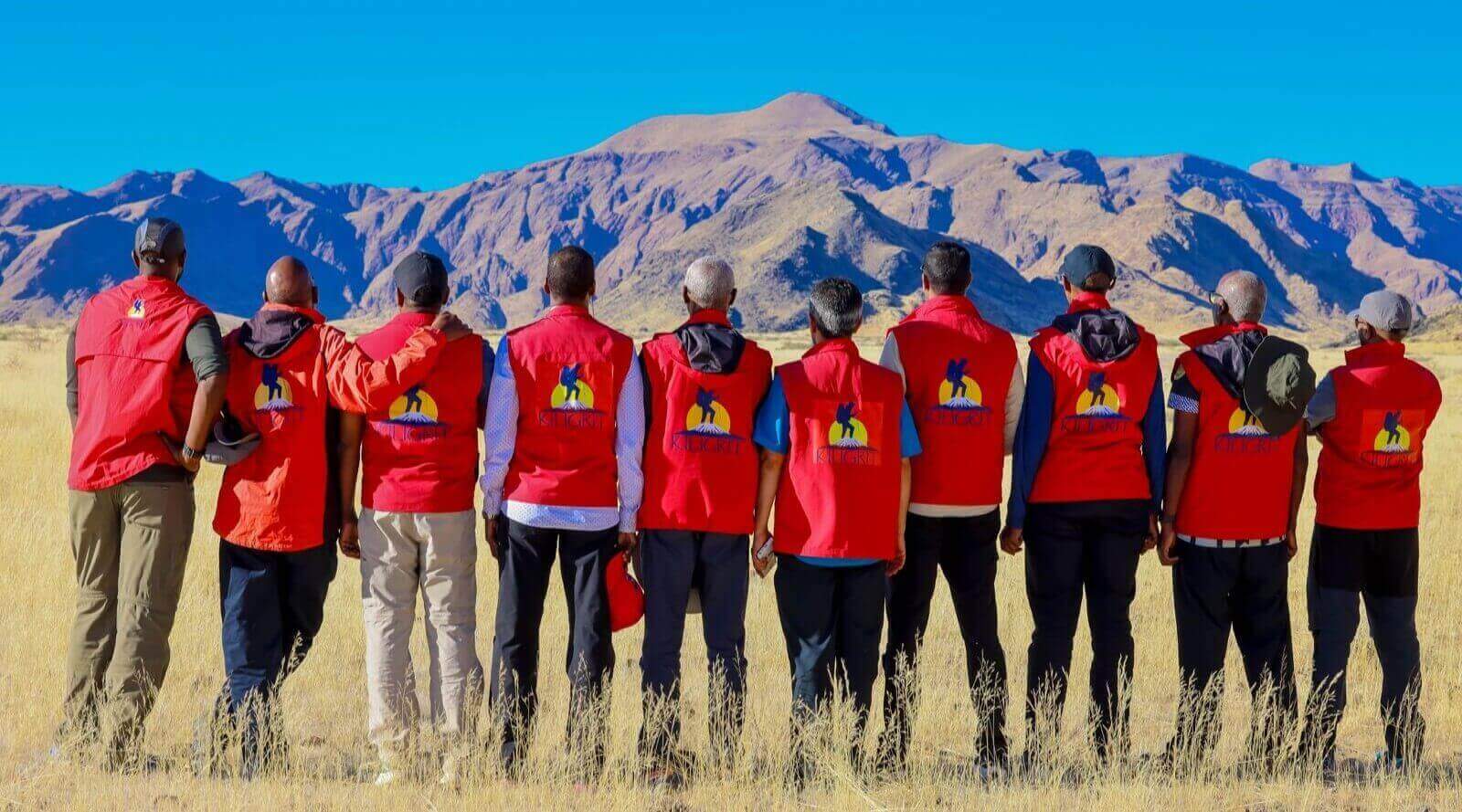
The Kiligrit team takes a moment to soak in the expansive landscape.
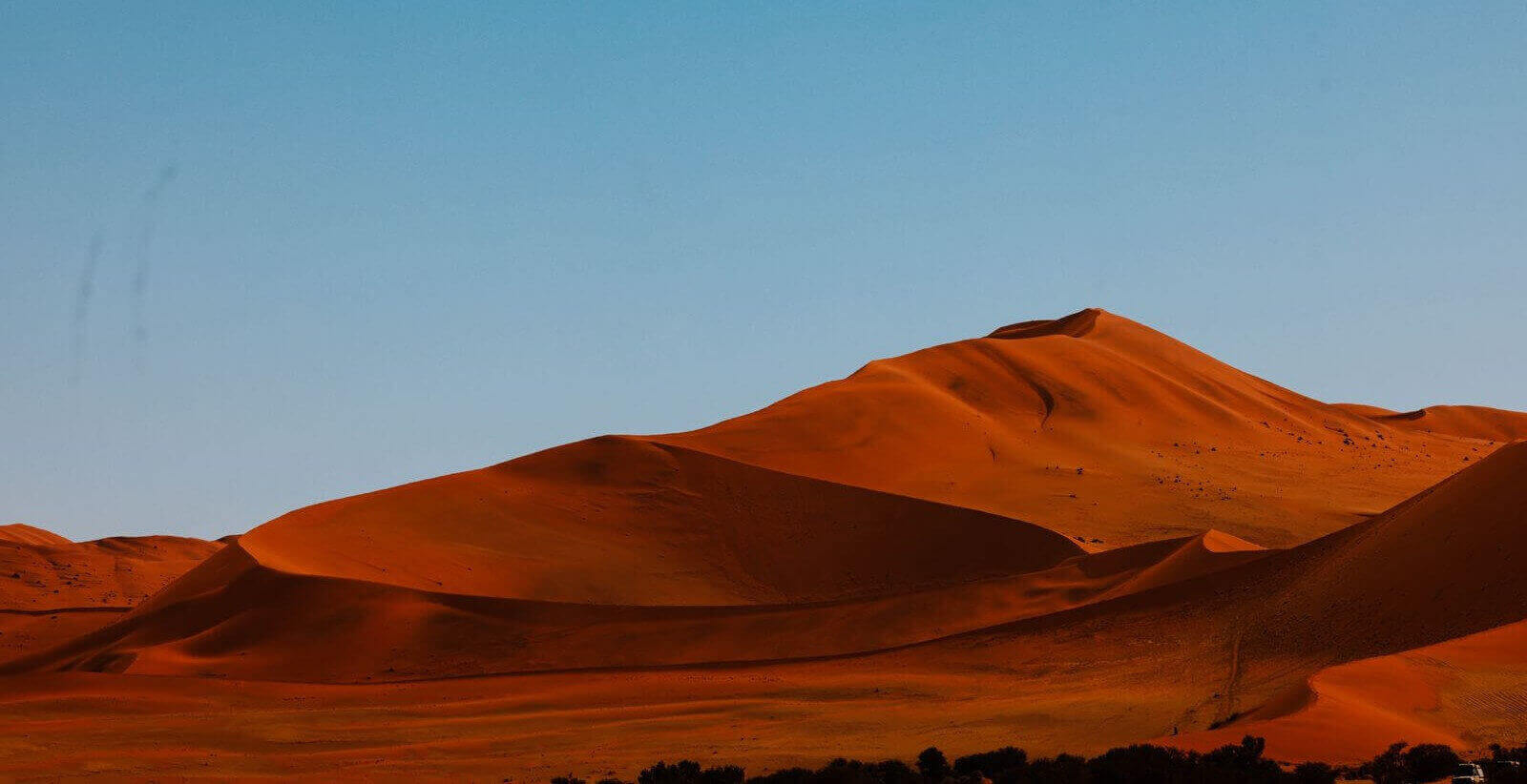
The best place of all is Sossusvlei. This place boasts of the tallest and most photographed dunes in the world. Here, it was like walking into a gallery that displays the Almighty God’s artistic creations. It was certainly the most surreal landscape we had ever seen.
At dawn on the following day, we joined a long queue of vehicles at Serium Gate waiting for registration and the opening of the park gate. Once cleared, we drove into the park as the sun announced itself to the earthly dwellers. As we drove across the Namib desert, we watched the colourful spectacle of hot-air balloons lifting from behind the hills one after the other, as an aircraft appeared above them, creating a field of aesthetics of joys.
We raced across the over 30,000 square-kilometre Namib Sand Sea on a lone road that stretches like 60-mile pier into the sea of sand, and in between towering dunes that seem to stand to attention either side of the road – creating one of the world’s most insistently memorable natural landscapes.
We went past Dune 45 and Big Mama, and headed for Big Daddy, to witness the dunes display a palette of colours from burnt orange to deep red, a display of a masterly show not found anywhere else. In the stillness of a foggy morning, it felt like the Red Sea parting in front of us.
At the end of the tarmac road, a river of deep sand begun. From here, the road gets really rough and sandy and in some places, it is hard to even tell which part is the road and which part is just more sand. Driving through this part requires high level of skill. It is in this section that we came upon a young French couple stuck in the sand. Their car was so deep in the soft sand that even with all our best efforts, we failed to dislodge it. It had to be towed.
One of our drivers went behind the wheel, while the other towed it out. Once their car was on a less challenging section, it was handed back to them. The couple were elated. The relief on their faces was there for all to see. With a bundle of dollars in her hand, the lady unsurely asked if she could give us some money as a token of thank you. We waved her away and wished them a safe journey.
Once at its base, we left our cars in a large lot among many cars to climb the Big Daddy, which at 325 metres, dwarfs all the other dunes. Climbing dunes is the done thing here, perhaps for the view, perhaps because conquering the sandy peaks scores a point against a landscape that monotonously insists on underlining man’s insignificance. We did for all the above and to earn the ultimate bragging rights.
We momentarily stood to admire the giant dune. The red sand appeared incredibly vivid at that time of the day. It had a blanket of intact grooves shaped by wind, and its edge was perfectly smooth. The rising sun gave one side a fiery red glow, while the other sat entirely in the shadows.
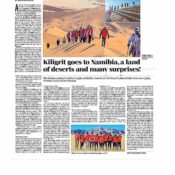
We started plodding up, slipping and sliding, and despoiling the perfect ridgeline. Our feet would sink into the loose sand. The excitement got better of Hussein Unshur and Abdikadir Speaker, who ran ahead of the team. Soon they stood staring at the distance, surprised by how challenging Big Daddy was. In essence, every step upward would only move one slightly as the foot slid down, diminishing any progress. Soon, we all spread out along a never-ending dune edge that kept pointing upwards. I looked back feeling guilty of leaving traces on this perfect specimen of natural piece of art.
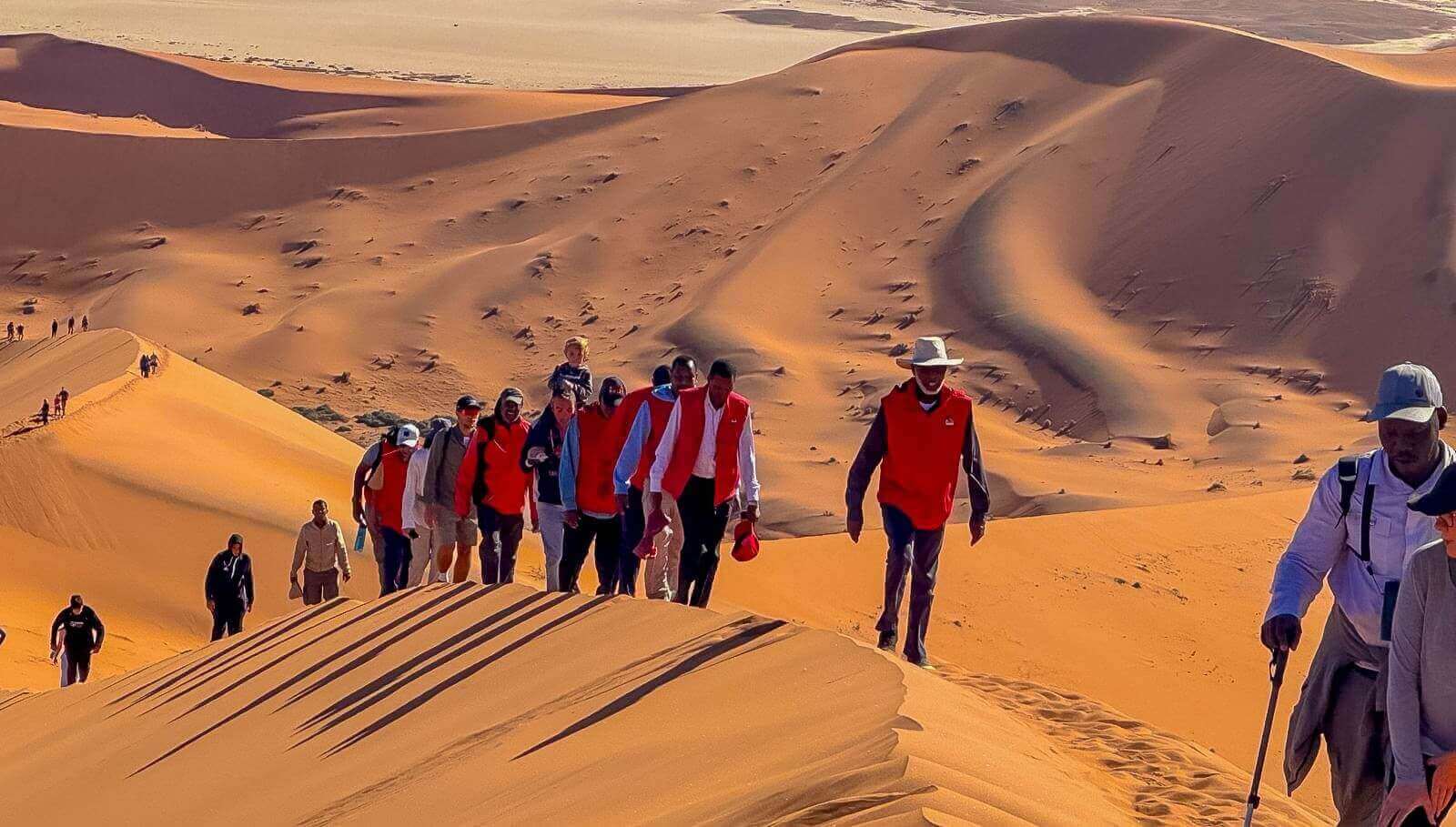
Leaving the cars behind, we started plodding up, slipping and sliding.
An hour later, we reached a crowded summit to stare at the ocean of dunes below, as the strangely hypnotic effect of this most photogenic of deserts, the profound tranquillity of its expansive wilderness, and faraway wonder overpowered our senses. But the thing is that these days everyone wants a taste of isolation, so the middle of nowhere can get very crowded. Though there are literally hundreds of dunes around here, all the tour parties converge on the same two – Dune 45 and Big Daddy. Under the perfect blue of the cloudless sky, it felt like we had driven to the end of the earth.
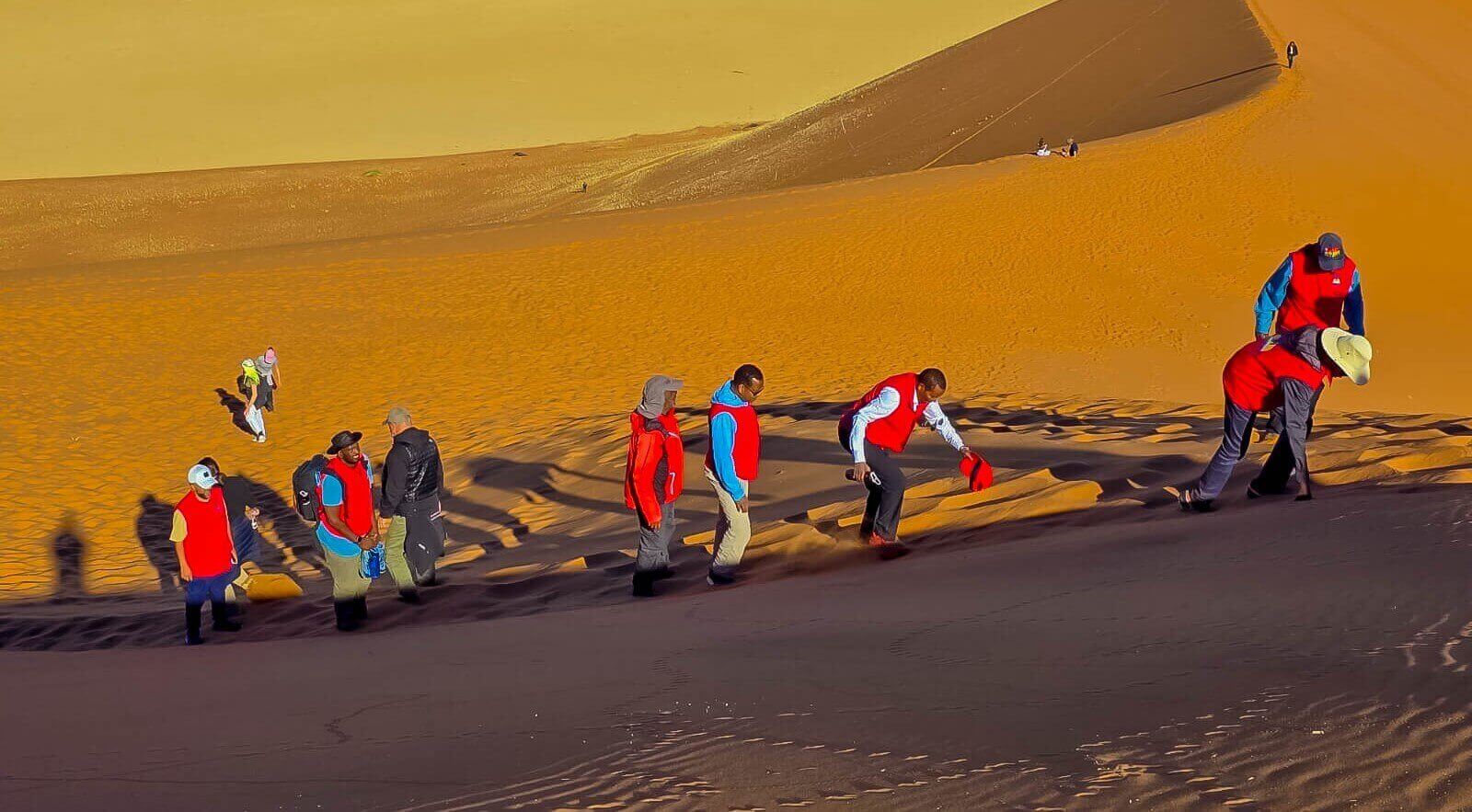
Scaling the massive sand dunes of the Namib desert is no joke.
Dead valley
At the foot of this giant dune lies Deadvlei, which offers a hauntingly beautiful scene. It features spaced out fossilised remains of ancient trees, their branches looking like the wands of skeletal wizards turned to stone by the wicked witch of the desert. It looks like what the name says, but it is arranged in a way that would shame even the most creative artist. Most intriguingly, the dead, leafless trees are still there, with blackened branches because of being starved of water for over 900 years since River Tsauchab changed course. The scene of a white floor with dead black ghostly looking trees surrounded with the red walls of Big Daddy and clear blue sky above, is sure to give you undoubtedly one iconic picture of Namibia.
As they say, if you up, you must go down. Mohamud went first and ran down Big Daddy into the Deadvlei. We watched as his figure became smaller and smaller on the sandy slope. We then appreciated how high we were. Notably, it is easy to lose a sense of scale on the world of giant dunes.
The rest of the team then followed, some running, some rolling on the sand, and others attempting to walk. I ran down barefoot, and stopped midway to lie on the sand and feel its softness. I looked back to watch Col Farah, HM, Elmi and Col Abdulbari, sing their way down together. Ahmed Jibril remained at the top to take pictures. Ali Daud was already in the pan trying to get a scientific explanation for the dead valley.
From the Namib Sand Sea to the Atlantic Ocean
After breakfast, we left our camp for the Atlantic Coast on a gravel but generously wide road. They call it “African massage” – to describe what you will experience when the gravel road beneath your wheels becomes so corrugated it rattles both man and machine. Head lights are kept on, to be seen through the dust.
We drove past mountains that could have been slushed into half during the Gondwana, with the other half drifting away to form what is now South America.
By this stage, we were becoming attuned to the desert – yellow grasses, orange sand, pink mountains – all muting to mauves and greys as the shadows shorten. Then we came upon billboards announcing the line of latitude at 23.5 degrees south of the Equator, that is otherwise known as the Tropic of Capricorn. We joined two busloads of Italian tourists out to live their Out of Africa fantasies, to record the moment. We could as well have been the first human beings on Mars.
Notably, cars are few and far between on this road, but when they do come, they trail huge plumes of dust, which momentarily blind you as they speed past.
Everyone seems to be in a hurry. In this desolate and forbidding land, the urge to escape the hostile environment is natural. For one long section, we are on a plain so flat and empty that the horizon is perfectly horizontal in every direction. The desert seems empty, but as we were to discover, that was not the case. We almost ran over an ostrich that stood up at the last moment and stubbornly challenged our vehicle to a 100-metre race.
After five hours of hard driving through endless grit and rock, the gravel road turned to tarmac. A sheet of blue ocean hummed through the sea fog, with the ghostly outlines of container ships suspended in it. Here, desert and sea meet, with nothing in between.
Read: Kiligrit: From the lowlands of northern Kenya to the highest point in Africa
After an overnight at Swakopmund, we were bused to Walvis Bay Waterfront for a three-hour boat ride to watch whales, seals, pelicans and other sea birds. By the time they were done with the safety briefing, I was shivering. The freezing cold comes straight off the Antarctica, so the sea is bitterly cold. On return to dry land, we headed for Sandwich Harbour.
Where the desert meets the ocean
The precarious 60km 4×4 drive along the beach to Sandwich Harbour, lying south of Walvis Bay, proved more enchanting than we anticipated. Here, some of the world’s highest sand dunes run straight into the Atlantic Ocean, creating breath-taking sceneries, unique landscapes and a picturesque lagoon.
The sand tracks’ varying consistencies and closeness to the water made driving an adventure in itself. At times, the path narrowed to less than a metre on each side of our vehicle, leaving us sandwiched between towering sand dunes on one side and incoming ocean waves on the other. This required impeccable timing, to pass some points, before the wave returns. At some sections, fog moves in and the path disappears. The driver would stop to wait for the fog to lift. In between the sound of the on-coming waves, Speaker would sneeringly remind me of the importance of learning how to swim.
Fortunately, aside from a few tense moments, we managed to capture an unforgettable experienced. Then we stopped at a spot where the dunes and the ocean had some distance between them, for lunch. We watched a line of vehicles struggle through the mud. Some members headed into the ocean while the others went up on all four to climb the near vertical dunes, and made it to the top to marvel at the site where the desert meets the sea.
We drove further out, left the track by the ocean, and found ourselves among sandy dunes. Up and down and over, our drivers enjoyed showing their sand driving skills, accelerating dramatically as we neared the edge of the last dune before the ocean, and would turn sharply to avoid flying into the water several hundred metres below. Here 300m dunes drop into the sea at the same angle as a cliff would. We watched the other car slide down a near impossible drop, disappear from view, before coming out on the next dune. I tried not to scream but gave out a sound only heard on summit night on Mount Kilimanjaro.
We stopped at a spot that no other scenery in the world could match. There was only blue and yellow in sight – perfect yellow, with nothing else on the horizon. Above was the clear blue sky, and below it, the waters of the Atlantic Ocean. The scenery came together as though painted by a master. I felt overpowered, not only by the geomorphology and the visual drama, but in realising the beauty of the Almighty God’s creation. You cannot get enough of this sight. As the poet Rumi once said, “All through eternity, beauty unveils God’s exquisite form in the solitude of nothingness.”
We ended our 10-day tour of Namibia with a visit to old rock engravings at Twyfelfontein; Damaraland; the Himba people with their traditional ochre-covered skin and intricate hairstyles; and Namibia’s premier national park, Etosha, which is undoubtedly one of the most incredible destinations on the planet, more particularly for people with passion for large concentrations of wildlife around water sources.
Namibia’s premier national park
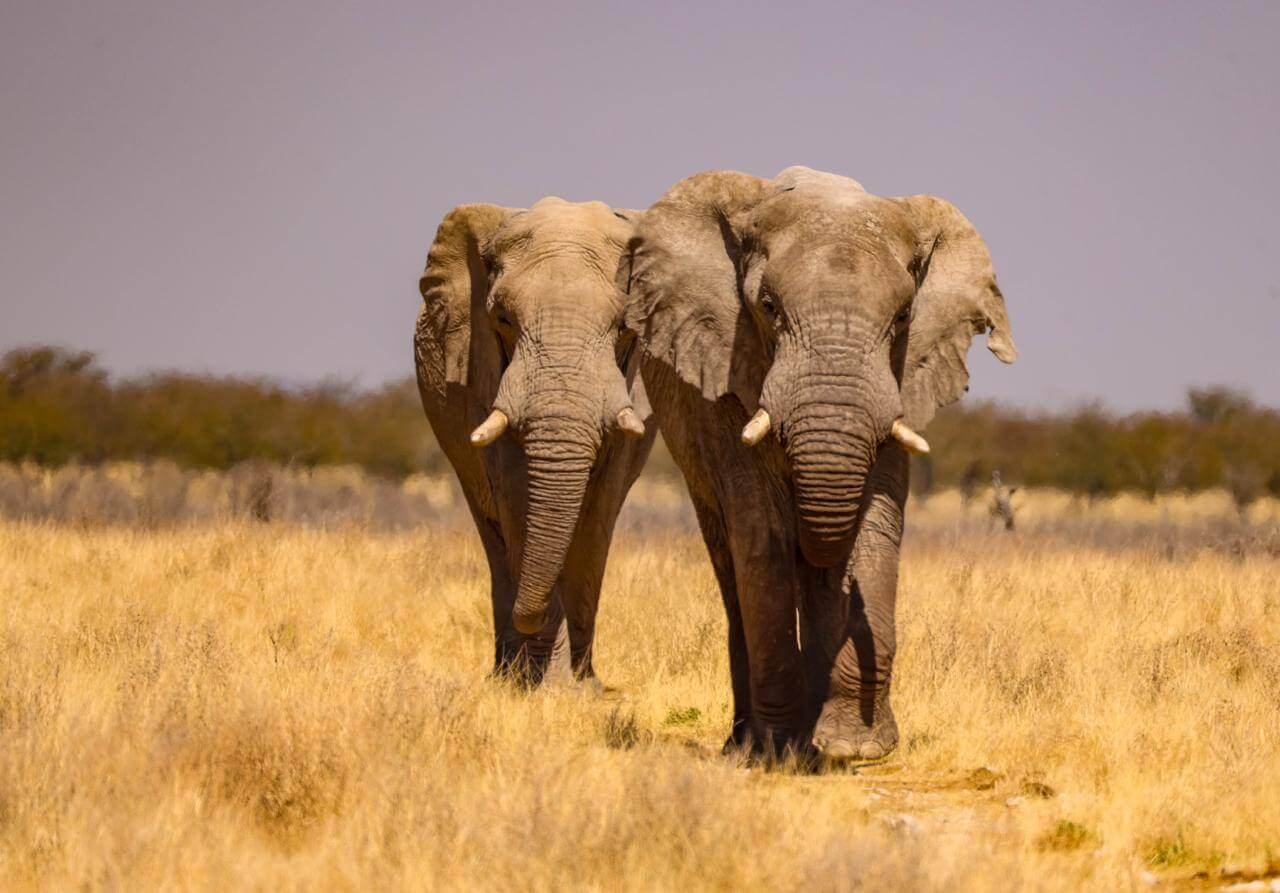
All other animals nervously withdrew when two giant elephants lumbered over.
At Etosha, we watched animals of all sizes drink in an orderly manner – a herd of zebras, a family of ostriches, a tower of giraffes, wildebeests, and a menagerie of desert antelope, all taking it in turns to use the waterhole, presumably following some long-agreed pecking order. All nervously withdrew, when two giant elephants lumbered over. A pride of nine lions laid lazily under a shade less than a kilometre away, waiting for sunset.
Allah commands people to “travel through the earth” to observe the natural world, understand God’s creative power, and gain wisdom. We did as it was divinely ordained and learnt from reflecting on this experience. Watch snippets in the video below:
Abdiwahid Biriq (@ABiriq) is a law practitioner and a senior partner at Sagana, Biriq & Muganda Advocates LLP
First Published in the Nation Newspaper